QPLOT Procedure |
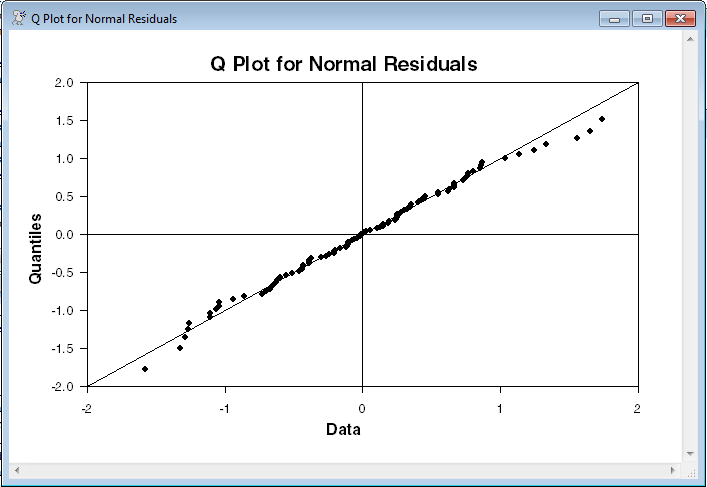
@QPlot creates a Q plot for a series against a hypothesized distribution.
@QPlot( options ) series start end
Parameters
|
series |
series to graph |
|
start, end |
range of series to graph. By default, the defined range of series. |
Options
DISTRIB=[NORMAL]/EXPONENTIAL
Determines the comparison distribution
SMPL=standard SMPL option[not used]
TITLE=" descriptive title for graph " [none]
MEAN=mean for comparison distribution [sample mean]
This applies to either comparison distribution.
STDDEV=standard deviation for comparison distribution [sample standard error]
This applies to either the Normal.
BOUND=lower bound for exponential distribution [0]
Example
*
* Brockwell & Davis, Introduction to Time Series and Forecasting, 2nd ed.
* Examples 5.2.5 and 5.3.3 from pp 164-167
*
open data lake.dat
cal 1875
data(format=free,org=columns) 1875:1 1972:1 lake
*
boxjenk(ar=1,ma=1,demean,maxl) lake
*
* Graph the residuals
*
graph(footer="Figure 5.5 Rescaled Residuals from ARMA(1,1) model")
# %resids
*
* REGCORRS is a procedure for doing a correlation analysis on residuals.
*
@regcorrs(number=40)
@bdindtests(number=22) %resids
*
* You can get the Jarque-Bera normality test as part of the output from a
* STATISTICS instruction.
*
stats %resids
@qplot(title="Q Plot for Normal Residuals") %resids
Sample Output
 p
p
Copyright © 2026 Thomas A. Doan