Page 1 of 2
Negative coefficient of leverage effect in TGARCH model
Posted: Mon Sep 04, 2017 12:37 pm
by jack
Dear Tom,
I have estimated an EGARCH(1,1). But the coefficient of leverage effect is negative and is grater than intercept coefficient (in absolute). Is my model correct?
I don't know how to interpret it.
I would be grateful if you could possibly guide me about it.
ARCH Model - Estimation by BFGS
Convergence in    54 Iterations. Final criterion was  0.0000074 <=  0.0000100

With Heteroscedasticity/Misspecification Adjusted Standard Errors
Dependent Variable RATE
Usable Observations                      1447
Log Likelihood                      4495.6509

    Variable                        Coeff      Std Error      T-Stat      Signif
************************************************************************************
1.  Constant                     -0.000031158  0.000048773     -0.63883  0.52293331
2.  RATE{1}                       0.856133277  0.127291467      6.72577  0.00000000
3.  Mvg Avge{1}                  -0.876589854  0.118661094     -7.38734  0.00000000

4.  C                             0.000002556  0.000001301      1.96424  0.04950200
5.  A                             0.102075484  0.036677992      2.78302  0.00538560
6.  B                             0.911473755  0.031339655     29.08372  0.00000000
7.  D                            -0.074174869  0.034559652     -2.14629  0.03185023
8.  Shape                         8.805227568  2.296427978      3.83431  0.00012591

Lag  Corr  Partial   LB Q    Q Signif
  1 -0.002  -0.002 0.0059098
  2  0.013   0.013 0.2454771
  3  0.003   0.003 0.2605999    0.6097
  4  0.005   0.005 0.2931223    0.8637
  5  0.020   0.020 0.8650255    0.8339
  6 -0.028  -0.028 1.9949604    0.7367
  7 -0.012  -0.012 2.1977440    0.8212
  8  0.028   0.029 3.3575772    0.7628
  9 -0.043  -0.043 6.1069826    0.5273
 10 -0.010  -0.011 6.2498157    0.6193

Q for Residual Serial Correlation       6.24982 significance level       0.61927
Lag  Corr  Partial   LB Q    Q Signif
  1 -0.021  -0.021 0.6507220
  2  0.049   0.048 4.1129728
  3 -0.010  -0.008 4.2493369    0.0393
  4 -0.008  -0.011 4.3408082    0.1141
  5  0.034   0.034 5.9924107    0.1120
  6 -0.013  -0.011 6.2396560    0.1820
  7  0.037   0.033 8.2542888    0.1428
  8 -0.020  -0.017 8.8482672    0.1823
  9  0.014   0.010 9.1388166    0.2428
 10 -0.013  -0.011 9.3775066    0.3115

McLeod-Li for Residual ARCH=       9.37751 significance level       0.31146
Re: Negative coefficient of leverage effect in TGARCH model
Posted: Mon Sep 04, 2017 1:00 pm
by TomDoan
That would be the usual sign for asymmetry in an EGARCH model. Read
https://estima.com/docs/RATS%209%20User ... f#page=311.
There is no expected relationship between the variance constant (which depends upon the scale of data) and the A, B and D (which don't).
Re: Negative coefficient of leverage effect in TGARCH model
Posted: Mon Sep 04, 2017 1:04 pm
by jack
Thank you very much for your kind reply.
Please correct me if I am wrong.
The intercept for negative news in TGARCH model is: C+D.
For my model it is: 0.000002556 + ( -0.074174869)= -0.074172313
So the intercept for negative news is negative which means that negative news will decrease volatility!!!
I am not sure the above interpretation is correct or not. Is it correct? Is it possible?
Re: Negative coefficient of leverage effect in TGARCH model
Posted: Mon Sep 04, 2017 1:24 pm
by TomDoan
That's wrong. Again, C has nothing to do with A, B and D. Read the formula on the page cited---the asymmetry term (with Nelson's sign convention) will give a double negative on a negative value.
Note also that EGARCH is not TGARCH, and, in fact, what many people describe as "TGARCH" isn't really TGARCH, it's GJR-GARCH. (TGARCH was actually a model in standard deviations).
Re: Negative coefficient of leverage effect in TGARCH model
Posted: Mon Sep 04, 2017 3:10 pm
by jack
I'm really sorry for asking too many questions.
I estimated the model. But I think the stability condition of the model dose not hold because: A+B >0.
Can I proceed to interpret the results while the stability condition is violated?
GARCH Model - Estimation by BFGS
Convergence in    27 Iterations. Final criterion was  0.0000001 <=  0.0000100

With Heteroscedasticity/Misspecification Adjusted Standard Errors
Dependent Variable RATE
Usable Observations                      1447
Log Likelihood                      4495.0760

    Variable                        Coeff      Std Error      T-Stat      Signif
************************************************************************************
1.  Constant                     -0.000187685  0.000266911     -0.70317  0.48194773
2.  RATE{1}                      -0.015836445  0.029724229     -0.53278  0.59418656

3.  C                             0.000002532  0.000001207      2.09820  0.03588724
4.  A                             0.106348449  0.035101727      3.02972  0.00244780
5.  B                             0.913067511  0.028087991     32.50740  0.00000000
6.  D                            -0.086025147  0.033127886     -2.59676  0.00941078
7.  Shape                         8.907688906  2.303923924      3.86631  0.00011049

Lag  Corr  Partial   LB Q    Q Signif
  1 -0.005  -0.005 0.0436946
  2 -0.003  -0.003 0.0565308    0.8121
  3 -0.009  -0.010 0.1868888    0.9108
  4 -0.006  -0.006 0.2385656    0.9711
  5  0.011   0.011 0.4065372    0.9819
  6 -0.036  -0.036 2.2628906    0.8117
  7 -0.019  -0.020 2.7922785    0.8344
  8  0.023   0.023 3.5496841    0.8299
  9 -0.048  -0.049 6.9765388    0.5392
 10 -0.014  -0.016 7.2756994    0.6084

Q for Residual Serial Correlation       7.27570 significance level       0.60844
Lag  Corr  Partial   LB Q    Q Signif
  1 -0.021  -0.021 0.6572427
  2  0.048   0.048 4.0336839
  3 -0.010  -0.008 4.1653618    0.0413
  4 -0.009  -0.012 4.2863524    0.1173
  5  0.031   0.031 5.6408703    0.1305
  6 -0.012  -0.010 5.8649898    0.2095
  7  0.035   0.031 7.6135899    0.1789
  8 -0.020  -0.018 8.2188185    0.2225
  9  0.014   0.011 8.5151899    0.2894
 10 -0.013  -0.011 8.7446755    0.3643

McLeod-Li for Residual ARCH=       8.74468 significance level       0.36429
Re: Negative coefficient of leverage effect in TGARCH model
Posted: Mon Sep 04, 2017 4:39 pm
by TomDoan
An EGARCH model is different from other models---the A and D terms are standardized, so they don't cause instability. Only the B term matters.
Re: Negative coefficient of leverage effect in TGARCH model
Posted: Mon Sep 04, 2017 11:26 pm
by jack
I'm really sorry. I think I made a mistake.
My model is just a simple GARCH with asymmetric effects ( GJR-GARCH). Here is the code:
Code: Select all
GARCH(P=1,Q=1,DIST=T,ASYMMETRIC,resids=resid,hseries=h,XREGRESSORS,REGRESSORS,ROBUST) / RATE
# Constant RATE{1}
# DUM DUMUS
Again my questions:
1. What is final effect of bad news? Is it C+D? Or, it is just D? And If it is C+D, who one can interpret C+D<0?
2. What about stability constraint? Is it A+B>0? Or, just B masters?
Re: Negative coefficient of leverage effect in TGARCH model
Posted: Tue Sep 05, 2017 9:47 am
by TomDoan
I have no idea why you think C is part of this. It's A+D for negative residuals and just A for positive ones. A+B+D/2 should be less than 1 to have a steady-state variance.
You might want to get the
ARCH/GARCH and Volatility Models e-course.
Re: Negative coefficient of leverage effect in TGARCH model
Posted: Tue Sep 05, 2017 4:07 pm
by jack
Thank you very much for your kind replies.
I am studying GARCH e-course.
Based on the course, I used two distribution for estimation: normal and t distribution.
But the results are very different about my policy variable "DUM".
When I use normal distribution, policy variable "DUM" is insignificant.
But when I use t distribution, it is significant. And although there is serial correlation between residuals, but there is a huge improvement for log-likelihood from 11807 to 11981.
I do not know which one I should choose because the results will be really different. Here is the results:
Normal distribution results:
ARCH Model - Estimation by BFGS
Convergence in    34 Iterations. Final criterion was  0.0000060 <=  0.0000100

With Heteroscedasticity/Misspecification Adjusted Standard Errors
Dependent Variable RATE
Usable Observations                      2844
Log Likelihood                     11807.6713

    Variable                        Coeff      Std Error      T-Stat      Signif
************************************************************************************
1.  Constant                      -8.2254e-05   5.9516e-05     -1.38204  0.16695844
2.  RATE{1}                           -0.0210       0.0165     -1.27245  0.20321490
3.  Mvg Avge{5}                        0.0876       0.0165      5.30374  0.00000011

4.  C                              2.4538e-07   9.7458e-08      2.51780  0.01180891
5.  A                                  0.1530       0.0424      3.60447  0.00031279
6.  B                                  0.8277       0.0442     18.72520  0.00000000
7.  D                                 -0.0315       0.0301     -1.04486  0.29608540
8.  DUM                            1.7999e-06   9.2451e-07      1.94683  0.05155462
9.  DUMUS                          6.2149e-07   3.6732e-07      1.69197  0.09065217


Statistics on Series USTD
Observations                  2844
Sample Mean               0.024851      Variance                   0.996143
Standard Error            0.998070      SE of Sample Mean          0.018715
t-Statistic (Mean=0)      1.327847      Signif Level (Mean=0)      0.184335
Skewness                  0.088641      Signif Level (Sk=0)        0.053751
Kurtosis (excess)         4.488669      Signif Level (Ku=0)        0.000000
Jarque-Bera            2391.279521      Signif Level (JB=0)        0.000000

Lag  Corr  Partial   LB Q    Q Signif
  1  0.020   0.020 1.1312780
  2  0.025   0.024 2.8780488
  3  0.011   0.010 3.2239692    0.0726
  4  0.004   0.003 3.2798873    0.1940
  5  0.015   0.014 3.8882123    0.2738
  6 -0.007  -0.008 4.0331484    0.4015
  7  0.016   0.016 4.7887327    0.4422
  8  0.009   0.008 5.0113929    0.5424
  9  0.005   0.004 5.0902846    0.6489
 10  0.032   0.031 7.9560055    0.4378

Q for Residual Serial Correlation       7.95601 significance level       0.43778
Lag  Corr  Partial   LB Q    Q Signif
  1  0.012   0.012 0.4151386
  2 -0.006  -0.006 0.5266433
  3 -0.006  -0.006 0.6177967
  4 -0.001  -0.001 0.6203289    0.4309
  5 -0.002  -0.002 0.6327680    0.7288
  6 -0.001  -0.001 0.6379565    0.8877
  7 -0.003  -0.003 0.6623797    0.9559
  8 -0.027  -0.027 2.7304108    0.7415
  9 -0.019  -0.018 3.7501168    0.7104
 10 -0.014  -0.014 4.3422914    0.7396

McLeod-Li for Residual ARCH=       4.34229 significance level       0.73962
T distribution results:
GARCH Model - Estimation by BFGS
Convergence in    35 Iterations. Final criterion was  0.0000040 <=  0.0000100

Dependent Variable RATE
Usable Observations                      2844
Log Likelihood                     11981.2214

    Variable                        Coeff      Std Error      T-Stat      Signif
************************************************************************************
1.  Constant                     -0.000078732  0.000048095     -1.63702  0.10162728
2.  RATE{1}                      -0.058785462  0.019814873     -2.96673  0.00300981
3.  Mvg Avge{5}                   0.065021259  0.016245536      4.00241  0.00006270

4.  C                             0.000000170  0.000000052      3.26377  0.00109942
5.  A                             0.176665976  0.034383348      5.13813  0.00000028
6.  B                             0.831687268  0.027515899     30.22570  0.00000000
7.  D                            -0.050342097  0.031611443     -1.59253  0.11126620
8.  DUM                           0.000001677  0.000000505      3.31912  0.00090302
9.  DUMUS                         0.000000881  0.000000377      2.33596  0.01949325
10. Shape                         4.177985298  0.363428331     11.49604  0.00000000


Statistics on Series USTD
Observations                  2844
Sample Mean               0.021170      Variance                   0.970569
Standard Error            0.985175      SE of Sample Mean          0.018473
t-Statistic (Mean=0)      1.145972      Signif Level (Mean=0)      0.251903
Skewness                  0.048609      Signif Level (Sk=0)        0.290177
Kurtosis (excess)         4.980581      Signif Level (Ku=0)        0.000000
Jarque-Bera            2940.653007      Signif Level (JB=0)        0.000000

Lag  Corr  Partial   LB Q    Q Signif
  1  0.051   0.051  7.432642
  2  0.026   0.024  9.397325
  3  0.013   0.011  9.893326    0.0017
  4  0.006   0.004  9.998996    0.0067
  5  0.034   0.033 13.299674    0.0040
  6 -0.008  -0.011 13.460646    0.0092
  7  0.016   0.016 14.218095    0.0143
  8  0.007   0.006 14.375270    0.0257
  9  0.007   0.006 14.524124    0.0426
 10  0.030   0.027 17.020960    0.0299

Q for Residual Serial Correlation      17.02096 significance level       0.02989
Lag  Corr  Partial   LB Q    Q Signif
  1  0.014   0.014 0.5785114
  2 -0.008  -0.008 0.7743542
  3 -0.008  -0.008 0.9449831
  4 -0.002  -0.002 0.9600899    0.3272
  5 -0.003  -0.003 0.9781284    0.6132
  6 -0.004  -0.004 1.0338654    0.7931
  7 -0.008  -0.008 1.2255420    0.8739
  8 -0.028  -0.028 3.5007252    0.6233
  9 -0.020  -0.019 4.6389526    0.5909
 10 -0.014  -0.014 5.1946818    0.6362

McLeod-Li for Residual ARCH=       5.19468 significance level       0.63622
Re: Negative coefficient of leverage effect in TGARCH model
Posted: Tue Sep 05, 2017 5:36 pm
by TomDoan
1. Multiply your data by 100. That won't change the results, but will get rid of those .00000x parameters.
2. 4 is a really small degrees of freedom for the t. Even allowing for a GARCH variance process, you have some monster outliers, and you should figure out what the source is.
Re: Negative coefficient of leverage effect in TGARCH model
Posted: Wed Sep 06, 2017 4:00 am
by jack
Thanks a lot for your excellent comments.
But it is really interesting for me why when I use t distribution there will be some correlations between residuals whereas it dosen't appear in estimation with normal distribution.
I examined the data. There are four outlires in the data due to periods of market turmoils.
I excluded those data and estimated the model again with normal distribution (robust errors). In this case, policy variable is barely signification in conventional significance level of 5%.
But I am skeptical about this procedure because results about the policy variable will be completely different (comparing to non-exclusion of those outliers).
Results with normal distribution (QMLE):
ARCH Model - Estimation by BFGS
Convergence in    32 Iterations. Final criterion was  0.0000037 <=  0.0000100

With Heteroscedasticity/Misspecification Adjusted Standard Errors
Dependent Variable RATE
Usable Observations                      2839
Log Likelihood                     -1220.4039

    Variable                        Coeff      Std Error      T-Stat      Signif
************************************************************************************
1.  Constant                     -0.008386793  0.005534301     -1.51542  0.12966600
2.  RATE{1}                      -0.029309051  0.021772045     -1.34618  0.17824506
3.  Mvg Avge{5}                   0.090295264  0.011990889      7.53032  0.00000000

4.  C                             0.001974856  0.000833254      2.37005  0.01778548
5.  A                             0.153841343  0.043628626      3.52616  0.00042164
6.  B                             0.843879821  0.040775108     20.69596  0.00000000
7.  D                            -0.039965335  0.033237885     -1.20240  0.22920740
8.  DUM                           0.010340398  0.005231483      1.97657  0.04809015
9.  DUMUS                         0.004003841  0.003345443      1.19680  0.23138282


Statistics on Series USTD
Observations                  2839
Sample Mean               0.024934      Variance                   0.995906
Standard Error            0.997951      SE of Sample Mean          0.018730
t-Statistic (Mean=0)      1.331255      Signif Level (Mean=0)      0.183212
Skewness                 -0.013314      Signif Level (Sk=0)        0.772237
Kurtosis (excess)         2.852676      Signif Level (Ku=0)        0.000000
Jarque-Bera             962.713089      Signif Level (JB=0)        0.000000

Lag  Corr  Partial   LB Q    Q Signif
  1  0.024   0.024 1.6222650
  2  0.027   0.027 3.7446754
  3  0.019   0.017 4.7327125    0.0296
  4 -0.000  -0.002 4.7327252    0.0938
  5  0.014   0.013 5.3137913    0.1502
  6 -0.005  -0.006 5.3909923    0.2495
  7  0.015   0.015 6.0556715    0.3008
  8  0.011   0.010 6.3887213    0.3811
  9  0.006   0.004 6.4754590    0.4855
 10  0.032   0.031 9.3906264    0.3104

Q for Residual Serial Correlation       9.39063 significance level       0.31042
Lag  Corr  Partial   LB Q    Q Signif
  1  0.021   0.021 1.2995890
  2 -0.002  -0.003 1.3116945
  3 -0.004  -0.004 1.3494367
  4 -0.001  -0.001 1.3544454    0.2445
  5  0.008   0.008 1.5248148    0.4665
  6 -0.001  -0.001 1.5274661    0.6759
  7 -0.017  -0.017 2.3121818    0.6786
  8 -0.020  -0.020 3.5038653    0.6228
  9 -0.022  -0.021 4.8980970    0.5569
 10 -0.008  -0.008 5.1028797    0.6474

McLeod-Li for Residual ARCH=       5.10288 significance level       0.64741
Re: Negative coefficient of leverage effect in TGARCH model
Posted: Wed Sep 06, 2017 10:02 am
by TomDoan
Getting "serial correlation" with t errors and not with Normal errors wouldn't be all that odd. The Normal log likelihood is such that it will do whatever it can to avoid six or eight standard deviation residuals, whether that's by increasing the variance or by reducing the raw residual. The t, particularly with a small degrees of freedom (like 4) has a likelihood that isn't as sensitive to outliers, and so will tend to have more and bigger ones. Outliers tend to throw off the Q tests. The actual values of the autocorrelations are quite small---they're only "significant" because you have 2800 data points. You may very well find that there is no systematic autocorrelation---if you do the same test with a partial range, you may get different results.
Re: Negative coefficient of leverage effect in TGARCH model
Posted: Wed Sep 06, 2017 10:22 am
by jack
I know that I am asking too many question and I am really sorry for this. I am learing verg goof point from you hear.
Would you recommend me to use a t distribution for estimation of the model?
I split the data set into two sets and hear is the results with
t distribution:
The whole period with policy variable (DUM):
GARCH Model - Estimation by BFGS
Convergence in    39 Iterations. Final criterion was  0.0000040 <=  0.0000100

Dependent Variable RATE
Usable Observations                      2844
Log Likelihood                     -1118.0281

    Variable                        Coeff      Std Error      T-Stat      Signif
************************************************************************************
1.  Constant                     -0.007820838  0.004440261     -1.76135  0.07817980
2.  RATE{1}                      -0.059778612  0.019005247     -3.14537  0.00165875
3.  Mvg Avge{5}                   0.064722329  0.015765723      4.10526  0.00004039

4.  C                             0.001744640  0.000520934      3.34906  0.00081086
5.  A                             0.183402447  0.032849827      5.58306  0.00000002
6.  B                             0.833135159  0.024059214     34.62853  0.00000000
7.  D                            -0.057433307  0.029451643     -1.95009  0.05116558
8.  DUM                           0.015101649  0.004423341      3.41408  0.00063997
9.  DUMUS                         0.029603899  0.014838842      1.99503  0.04603987
10. Shape                         4.174541495  0.344993198     12.10036  0.00000000


Statistics on Series USTD
Observations                  2844
Sample Mean               0.022184      Variance                   0.966196
Standard Error            0.982953      SE of Sample Mean          0.018432
t-Statistic (Mean=0)      1.203597      Signif Level (Mean=0)      0.228846
Skewness                  0.087003      Signif Level (Sk=0)        0.058334
Kurtosis (excess)         4.846544      Signif Level (Ku=0)        0.000000
Jarque-Bera            2787.033378      Signif Level (JB=0)        0.000000

Lag  Corr  Partial   LB Q    Q Signif
  1  0.050   0.050  6.987297
  2  0.029   0.026  9.328924
  3  0.011   0.008  9.667582    0.0019
  4  0.006   0.005  9.776043    0.0075
  5  0.037   0.036 13.590865    0.0035
  6 -0.003  -0.007 13.622005    0.0086
  7  0.017   0.016 14.472146    0.0129
  8  0.005   0.003 14.545499    0.0241
  9  0.010   0.009 14.828460    0.0383
 10  0.032   0.030 17.756342    0.0231

Q for Residual Serial Correlation      17.75634 significance level       0.02313
Lag  Corr  Partial   LB Q    Q Signif
  1  0.012   0.012 0.4286678
  2 -0.009  -0.009 0.6726470
  3 -0.007  -0.007 0.8237992
  4 -0.000  -0.000 0.8238625    0.3641
  5 -0.003  -0.003 0.8430530    0.6560
  6 -0.004  -0.004 0.8921541    0.8273
  7 -0.009  -0.009 1.1266579    0.8900
  8 -0.029  -0.029 3.6058852    0.6074
  9 -0.022  -0.022 5.0060801    0.5430
 10 -0.015  -0.015 5.6216068    0.5846

McLeod-Li for Residual ARCH=       5.62161 significance level       0.58456
The first period without policy variables:
GARCH Model - Estimation by BFGS
Convergence in    28 Iterations. Final criterion was  0.0000010 <=  0.0000100

Dependent Variable RATE
Usable Observations                      1482
Log Likelihood                        49.6606

    Variable                        Coeff      Std Error      T-Stat      Signif
************************************************************************************
1.  Constant                     -0.007406901  0.004921986     -1.50486  0.13236001
2.  RATE{1}                      -0.092404961  0.025376191     -3.64140  0.00027116
3.  Mvg Avge{5}                   0.078082591  0.022645578      3.44803  0.00056470

4.  C                             0.002737456  0.000884780      3.09394  0.00197518
5.  A                             0.423712959  0.100418985      4.21945  0.00002449
6.  B                             0.725089611  0.042898848     16.90231  0.00000000
7.  D                            -0.172858241  0.082975547     -2.08324  0.03722906
8.  Shape                         3.742372887  0.392369363      9.53788  0.00000000

Lag  Corr  Partial   LB Q    Q Signif
  1  0.061   0.061  5.581298
  2  0.064   0.060 11.656283    0.0006
  3  0.011   0.004 11.849670    0.0027
  4  0.010   0.006 12.012277    0.0073
  5  0.048   0.047 15.502665    0.0038
  6 -0.019  -0.026 16.065776    0.0067
  7  0.015   0.012 16.402284    0.0118
  8 -0.008  -0.008 16.504777    0.0209
  9  0.014   0.013 16.814939    0.0321
 10  0.038   0.035 18.946801    0.0256

Q for Residual Serial Correlation      18.94680 significance level       0.02565
Lag  Corr  Partial   LB Q    Q Signif
  1  0.007   0.007 0.0745647
  2 -0.024  -0.024 0.9110453
  3 -0.018  -0.018 1.3944078
  4 -0.006  -0.007 1.4529241    0.2281
  5 -0.024  -0.025 2.2907667    0.3181
  6 -0.008  -0.008 2.3854261    0.4964
  7 -0.032  -0.033 3.9079688    0.4186
  8 -0.042  -0.043 6.5066853    0.2600
  9 -0.035  -0.037 8.3359035    0.2145
 10 -0.010  -0.014 8.4956138    0.2909

McLeod-Li for Residual ARCH=       8.49561 significance level       0.29092
The second period without policy variables:
GARCH Model - Estimation by BFGS
Convergence in    25 Iterations. Final criterion was  0.0000014 <=  0.0000100

Dependent Variable RATE
Usable Observations                      1362
Log Likelihood                     -1151.9876

    Variable                        Coeff      Std Error      T-Stat      Signif
************************************************************************************
1.  Constant                      0.002130143  0.014201408      0.15000  0.88076842
2.  RATE{1}                      -0.025285012  0.026332577     -0.96022  0.33694556

3.  C                             0.009426304  0.003780443      2.49344  0.01265122
4.  A                             0.085579793  0.021176255      4.04131  0.00005315
5.  B                             0.911505080  0.021306560     42.78049  0.00000000
6.  D                            -0.045953560  0.021834267     -2.10465  0.03532151
7.  Shape                         5.252726839  0.724454957      7.25059  0.00000000

Lag  Corr  Partial   LB Q    Q Signif
  1  0.043   0.043  2.529719
  2 -0.032  -0.034  3.927007
  3  0.003   0.006  3.939321    0.0472
  4  0.009   0.007  4.039869    0.1327
  5  0.053   0.053  7.856684    0.0491
  6  0.012   0.008  8.068005    0.0891
  7  0.003   0.006  8.084312    0.1516
  8  0.029   0.029  9.210030    0.1621
  9  0.006   0.003  9.265234    0.2342
 10  0.033   0.032 10.739803    0.2169

Q for Residual Serial Correlation      10.73980 significance level       0.21688
Lag  Corr  Partial   LB Q    Q Signif
  1 -0.010  -0.010 0.1383868
  2 -0.013  -0.013 0.3661614
  3 -0.018  -0.018 0.8132224
  4 -0.001  -0.002 0.8162768    0.3663
  5  0.018   0.017 1.2400000    0.5379
  6 -0.003  -0.003 1.2486957    0.7414
  7  0.023   0.024 2.0049901    0.7348
  8 -0.010  -0.009 2.1445085    0.8288
  9 -0.001  -0.001 2.1462277    0.9058
 10 -0.018  -0.018 2.6098688    0.9186

McLeod-Li for Residual ARCH=       2.60987 significance level       0.91860
Re: Negative coefficient of leverage effect in TGARCH model
Posted: Wed Sep 06, 2017 11:07 am
by TomDoan
What happened to your MA{5} in the second half? Assuming that you found that it's insignificant, what does that tell you? To me it sounds like it fixed a "one-off" outlier that came five periods after another one, that is, it's not really part of a proper model. Don't let diagnostics get in the way of sensible modelling.
You seem to have rather dirty data, so you probably need the t.
Re: Negative coefficient of leverage effect in TGARCH model
Posted: Wed Sep 06, 2017 1:58 pm
by jack
I appreciate your help.
The MA{5} in the second half is not significant (its p-value is 0.058). If I delete this term in first half and the whole sample, there will be some correlations between the residuals. If I delete it I do not know how to convince the referee of the paper about the correlations!!!. I certainly use your excellent comments.
Here is Standardized Residuals for total observations:
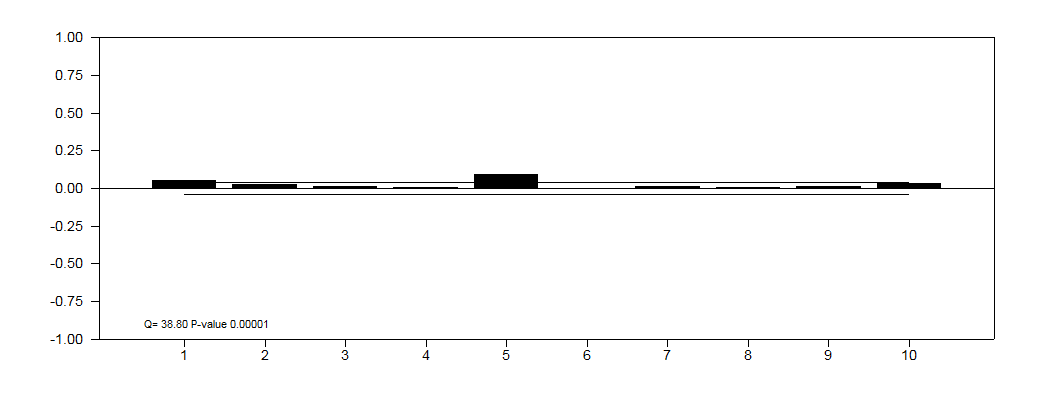
- total.png (11.88 KiB) Viewed 26643 times
Here is Standardized Residuals for first half:
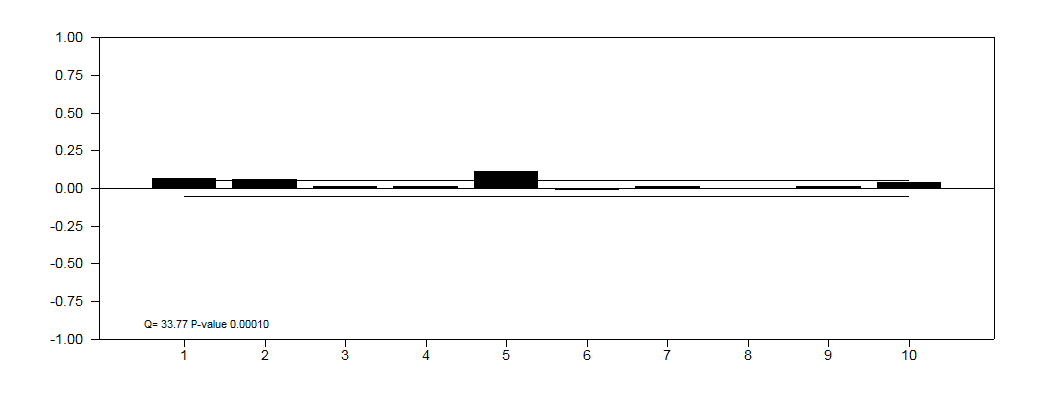
- first half.png (11.97 KiB) Viewed 26643 times
As I said before, my goal is this: I want to see if the introduction of futures contract have led to higher volatility in spot market. I followed your recommendation to use GARCH-X model. I control it by "DU" variable in GARCH-X model. So, I estimate the model with total observations.
But I also want to see if the introduction of futures contract have increased the pace of new information absorption into spot prices. I examine this by comparing the coefficient "A" of these two regressions: one before introduction and another after introduction of contract.